Antikythera
- Design
- Channel Studio
- Published
- DOI
- 10.1162/ANTI.5CZ9
- Length
- ~13k words
- Original
- Read the original
A new philosophy of computation links an evolutionary perspective on technology in general, and the emergence of planetary computation in particular, with a generative program for how to re-orient it.
Summary#
"Antikythera" is Benjamin Bratton's research statement for the program of the same name, published as the framing text of the journal's first issue. It argues that planetary-scale computation has outrun the concepts available to describe it, and that the right response is not to judge computation by inherited philosophical standards but to build a new speculative philosophy out of computational media themselves. Computation, on this account, is less a tool than the principal means by which intelligence has come to perceive the planetary conditions of its own existence, from climate models to the Event Horizon Telescope. The statement lays out the program's four research tracks, Synthetic Intelligence, Recursive Simulations, Hemispherical Stacks, and Planetary Sapience, and closes with an evolutionary account in which life, intelligence, and technology are successive scaffolds for one another, with artificial intelligence the latest and not the last. Nearly every later work in the journal is positioned here as a contribution to one of these tracks.
The argument#
Bratton opens with a diagnosis. There are periods when imagination outruns technical capacity and produces utopias, and periods when technical capacity outruns the concepts needed to understand it. The present is the second kind, a "civilization-scale computational overhang" in which human agency exceeds human wisdom. Philosophy should treat this as an occasion for invention rather than apply settled ideas about ethics and polity to a situation already generating its own framework. His example of what not to do is asking whether AI can think by Kant's standards, which he compares to asking whether a creature found in the New World is really an animal by Aristotle's definition. New evidence should update the category, not be judged by it.
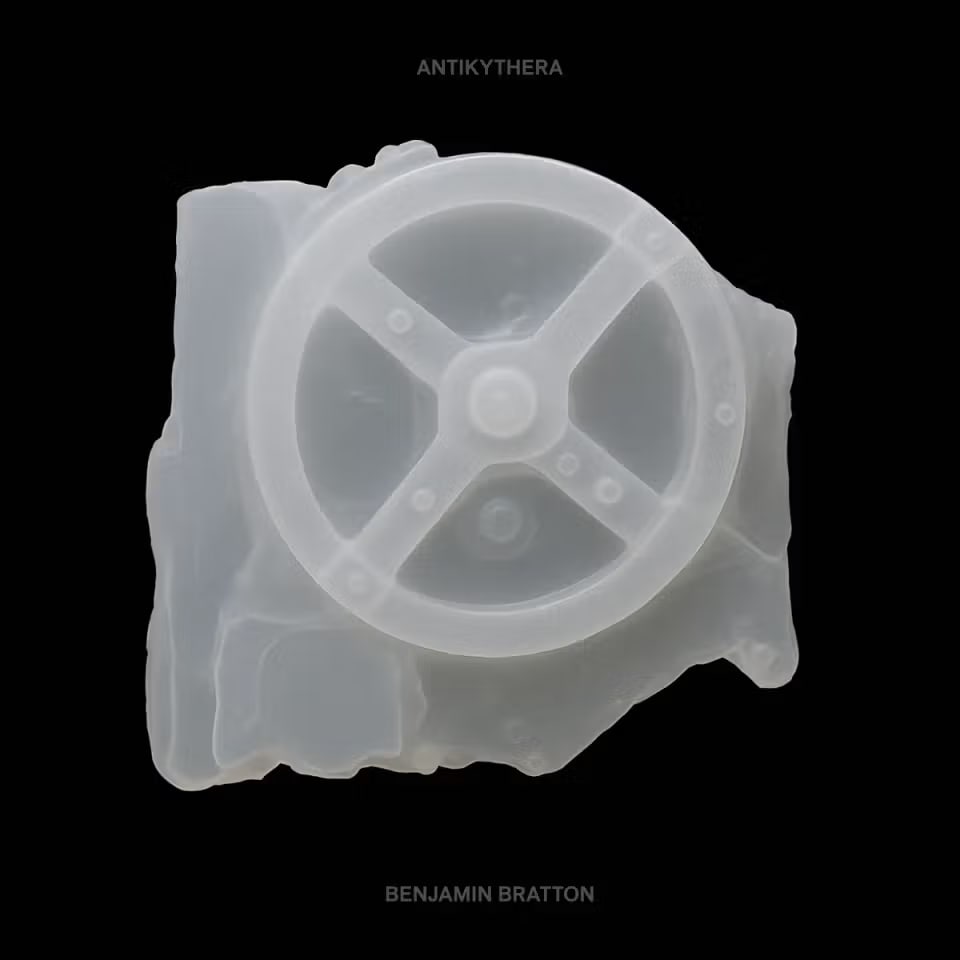
The method follows from this. Antikythera does not apply philosophy to computation; it starts from the other direction and draws concepts from "living computational media." The program takes its name from the Antikythera mechanism, the astronomical device of around 200 BCE, because that object was not merely a calculator but an orientation of thought toward the astronomical predicament of its users. Two premises are stated early and used throughout. First, computation was discovered as much as invented: modern devices are approximations of natural computation, genetic, molecular, and neuronal, rather than the reverse. Second, intelligence is a planetary phenomenon that evolves through the scaffolding interactions of genetic, biological, technological, and linguistic systems, and is not the property of any one species or machine.
From these premises Bratton defines his stance against two rival traditions. Analytic philosophy of computation interrogates the formal properties of calculation; continental philosophy treats computation as a figure of power and valorizes the incomputable over the computable. Antikythera's stance is "allocentric," Copernican rather than phenomenological: we learn more about ourselves by getting outside our own perspective through technological mediation than by introspection. Humans are "the medium, not the message," the present seat of an intensifying abstract intelligence that is the real actor.
The middle of the text applies this to the planetary. Planetary computation has two connotations: a global technical apparatus, and the way that apparatus reveals conditions that would otherwise be unthinkable. Climate change is the central case. It is knowable only through satellites, sensors, and supercomputer simulations, so the Anthropocene is a "second-order concept derived from computation." The Event Horizon Telescope, which turned the rotating Earth into a single compound eye and produced the first image of a black hole, shows what planetary computation is for.
The four tracks each restate the core claim at a different scale: machine intelligence widens what intelligence is; simulations act back on what they model; computation reorganizes geopolitics into competing hemispherical stacks; and all of this sits within the long evolution of planetary intelligence. The final section supplies the evolutionary theory underneath. Drawing on assembly theory, Bratton argues that evolution selects for forms of life capable of transforming their environment, that technology and intelligence have co-evolved as mutually dependent scaffolds, and that AI is the artificialization of the very force that drove artificialization. It is therefore a scaffold for something unforeseeable, not an end point and not a tool. The text ends on the paradox that gives the program its urgency: planetary sapience is cosmically rare and fragile, and its own emergence has produced the conditions that endanger it.
Section by section#
Introduction#
Subtitled "Everything's Computer!", the introduction frames the project as an attempt to create "the Philosophy of the 21st century before it is too late." Bratton lists the phenomena forcing the issue, from neuromorphic and biochemical computing to chip wars and informational theories of biology, and claims that sciences are born when philosophy asks the right questions. He concedes that concept invention puts the program in a "slightly heretical position" relative to the humanities as they stand.
The subsection on computation and cosmology gives the origin story and the working definition. The Antikythera mechanism is both the first artificial computer and an astronomical instrument, and that conjunction is the point. Computation is defined broadly as a rules-based, output-generating operation spanning biological processing and universal Turing machines, and "AI" is said to be becoming computation's primary societal form rather than an application of it. Sumerian cuneiform is the example of computation as world ordering: the first writing was accounting. The subsection on allocentrism sets out the position against analytic and continental approaches and adds that machine intelligence evolving through language, and language through machines, suggests "a sort of artificial convergent evolution."
Planetary Computation#
Bratton retells the blue marble image as a 4.5-billion-year film in which, in the final seconds, Earth grows a crust of satellites, cities, and networks, a "sensory epidermis or exoskeleton." Planetary computation is this crust understood as a "geological cognitive phenomenon." The Anthropocene subsection argues that the category is an epistemological accomplishment of computation, and welcomes the recent decision to classify the Anthropocene as an event rather than an epoch, since events are transformative but not final and can be steered. "Artificialization" is given a specific meaning here: not fake, but the product of deliberate conceptual prefiguration, as with chips and software.
The subsection on the planetary as a "humanist category" contains the text's most direct attack on Heidegger, whose suspicion of perception beyond grounded phenomenology Bratton says has "confused generations of young minds." His counterclaim is that every Copernican turn, heliocentrism, Darwinism, neuroscience, machine intelligence, has required getting outside our own skin, and that this is closeness to Being. The Event Horizon Telescope passage defines what "disclosing and accelerating planetary intelligence" means: a planet that "finally opens its eye to perceive its distant environment."
Research Program#
Bratton rejects both "philosophy of technology using design methods" and "speculative design driven by philosophy" as descriptions of the program and proposes a conjunction of philosophy and engineering, with functionalism as a constraint that is perhaps creativity's "most fertile niche." The "science wars," which the humanities "absolutely did not win," are treated as a self-inflicted retreat into social reductionism.
The method is "Conceive, Convene, Communicate": a conceptual vocabulary posed as definitions and framing questions, a convened network of affiliates across disciplines, and investment in the design of communication so that each output adds to a "high-resolution mosaic." The annual studios, the MIT Press book series beginning with Agüera y Arcas's What Is Intelligence?, and the digital journal are described here. The Research Areas subsection defines the four tracks in a paragraph each and flags two emphases for Synthetic Intelligence: productive misalignment and the avoidance of "alignment overfitting," and the open-world artificial evolution of hybrid intelligences.
Synthetic Intelligence#
The section heading asserts that the lesson of AI is less humans teaching machines to think than machines demonstrating that thinking exists on "a much wider and weirder spectrum." Bratton traces the coupled history of AI and philosophy of AI from Leibniz through Turing and Dreyfus, widened to Deng-era cybernetics and Lem's "existential" technology. His central complaint is reflection: AI is defined against the human and the human against AI, so people see their own society in the mirror and fail to understand machine intelligence as it is.
The subsection on weirdness takes LLMs as the case. Language, once the structuralist's "house" for humans, has become uncanny now that machines produce coherent text at inhuman rates, and foundation models are becoming general-purpose utilities, which Bratton names "cognitive infrastructures." He quotes his Noema essay with Agüera y Arcas: reality overstepping vocabulary is the start of the conversation, not its end. Sidebars summarize The Model Is the Message (the Lemoine and LaMDA episode, read as anthropomorphic projection about a system nonetheless intelligent in specific ways), the Five Stages of AI Grief essay, and the After Alignment lecture. A short passage on "fire apes" making rocks think recasts the blue marble story as a sequence of substrates, animal, vegetal, and now mineral intelligence.
The alignment passage is the track's main normative claim. Alignment to human wants is "a necessary short-term tactic and an insufficient and even dangerous long-term norm." The telescope did not merely magnify; it changed how we see ourselves. "Productive disalignment," dragging society toward AI's insights, is held to be just as essential. The subsection on cognitive infrastructures then moves from single-user chatbot relations to "AI in the wild": intelligence that evolves at environmental scale among multiple agents, on substrates that need not be brain tissue or silicon, with the most unfamiliar interactions occurring between AIs without human involvement.
Recursive Simulations#
Bratton begins with Plato's cave and inverts it: today the real comprehends itself through its doubles, so simulation is the path toward knowledge rather than away from it. Simulation is "a practice without a theory." Recursive simulations both depict the world and act on what they simulate; the examples range from financial models and digital twins to user interfaces and "prophetic stories."
The politics subsection observes that scientific simulation and virtual reality have inverse relations to the real: one makes an inaccessible reality perceivable, the other bends reality to what one wants to see. "In between is where we live." The subsection on existential implications distinguishes direct from reflexive recursion and uses climate politics as the paradigm of the latter: simulations of 2050 are dire, so politics mobilizes now to prevent that future, conferring extraordinary agency on the models. Bratton notes that activists may not welcome this description, but holds that it is why they are in the streets.
Pre-perception argues that prediction often precedes description: black holes were described mathematically, rendered for Interstellar with Kip Thorne's help, and only afterwards imaged. Two short subsections follow, on toy worlds (cortical columns run constant predictive simulations; driverless cars train in simulated environments) and on models, defined as radical reductions whose descriptive value is licensed by their predictive value. The latter ends with the claim that cosmology in the anthropological sense is now achieved through cosmology in the computational sense.
Hemispherical Stacks#
The section restates The Stack as an "accidental, discontiguous megastructure" of six layers, Earth, Cloud, City, Address, Interface, User. Platforms took on state functions and states became platforms; in the last few years the result has fragmented into a North Atlantic-Pacific stack, a Chinese stack, and divergent courses charted by India, the Gulf, Russia, and Europe. The track's thesis is that the shift to multipolar geopolitics and the shift to multipolar computation "are, in many respects, the same thing." A New Map notes "Galapagos effects" of encapsulated information cultures; The AI Stack lists the transitions under way, from infrastructure to cognitive infrastructure, from storing information to training models, from Von Neumann to neuromorphic architectures: "this is not science fiction; this is last week."
Chip Race argues that if society runs on computation, the ability to make chips is the ability to make a society, and cites the Cloud Megaregionalization project on the regional planning, from Arizona to Malaysia to Bangalore, that now sites cloud manufacturing. Astropolitics extends the stack above the Kármán line, observes that consumer miniaturization now feeds the space race rather than the reverse, and ends on the "Copernican trauma" of a ground that is a gravitational plane and a sky that is a time machine.
The two closing subsections are polemical. The Technical Milieu of Governance distinguishes the political, the agonistic contest over symbols of power, from governance, a system's capacity to sense, model, and act on itself, and argues that planetary computation is not something to be governed from outside but is governance in its most direct sense. Beyond Cultural Determinism criticises the humanities' habit of treating cultural pluralism as a remedy for computation's global emergence and of framing the situation as a clash of reified civilizations with distinct "ways of being technological." Bratton quotes his original essay: we may look back on separate pasts but will inhabit conjoined futures, and computation did not abolish the outside so much as reveal that there never was one.
Planetary Sapience#
The final track asks what the relationship between the planetary and intelligence must be, and answers with two words: disclosure and composition. Intelligence emerged from a planetary condition only recently disclosed to it through technological perception; the task now is to compose a viable coupling of biosphere and technosphere. The lesson drawn is that "agency preceded subjectivity": humans terraformed the planet for centuries before comprehending the effects. Sentience becomes sapience when sensory awareness becomes judgment and governance. Modes of Intelligence disclaims any single noosphere and lists the program's working lines of inquiry.
The subsection on the evolution of artificialization is the theoretical centre of the text. Bratton adopts Walker and Cronin's assembly theory, on which selection begins with chemistry, and defines life as populations that cooperatively capture energy, matter, and information for collective replication. Evolution, he argues, selects for allopoiesis, the capacity to transform the environment into external systems, and hence for artificialization. Technology is "a durable scaffolding apparatus" that lets intelligent agents transform matter, energy, or information at otherwise impossible scales. Intelligence, technology, and language form a chain of scaffolds, with thresholds at language, symbolic forms, coded notation, condensed energy, and artificialized computation. The question is what happens when intelligence, the driver of artificialization, is itself artificialized, and what AI is in turn a scaffold for. Bratton's answer is that AI replicates autopoietically and allopoietically, is "life if not also alive," and that calling it a tool is a serious mistake. Scaffolds are not replaced by what they enable; they are amplified.
Life/Intelligence/Technology states the convergence directly: the three definitions are coming to look alike, each a factory for the others and perhaps the same factory. The closing subsection quotes the "decisive paradox" of planetary sapience from the 2023 essay and asks whether complex intelligence is adaptive or maladaptive, given that it remakes the planet in its image. The text does not answer; it asks what would make it adaptive, and closes with the claim that all philosophy and all engineering are intrinsically planetary.
Key concepts#
- Computational overhang — The condition in which the capabilities and implications of planetary-scale computation exceed the concepts available to describe or guide them; the statement's diagnosis of the present. Computational Overhang (civilization-scale)
- Allocentrism — The stance that we learn about ourselves by getting outside our own perspective, usually through technological mediation, rather than through introspection. Allocentrism
- Planetary computation — Both the global technical apparatus and the epistemological work it does in revealing planetary conditions; a "geological cognitive phenomenon." Planetary Computation
- Artificialization — Not fakery but deliberate conceptual prefiguration; in the final section, the allopoietic capacity that evolution selects for, which AI now turns on intelligence itself. Artificialization
- Productive disalignment — The claim that society must be dragged toward AI's insights as much as AI is bent to human values; alignment is a short-term tactic, not a long-term norm. Productive Disalignment
- Cognitive infrastructures — Foundation models and AI-saturated systems as general-purpose utilities; the infrastructuralization of AI and the "making cognitive" of infrastructure. Cognitive Infrastructures
- Recursive simulation — A simulation that both represents the world and acts on what it represents; reflexive recursion is the case of acting to fulfil or prevent a simulated future. Reflexive vs. Recursive Simulation
- Hemispherical stacks — The fragmentation of planetary computation into competing sovereign stacks, held to be the same process as the return of multipolar geopolitics. Hemispherical Stacks
- Technical milieu of governance — Governance, as a system's capacity to sense, model, and act on itself, always exists within a technical milieu; planetary computation is governance rather than an object of it. Technical Milieu of Governance
- Scaffolding — The evolutionary pattern in which each form (chemistry, life, intelligence, language, technology, AI) enables a more complex successor without being replaced by it. Scaffolding
- Allopoiesis — The transformation of the environment into systems external to the agent; the basis of technology and, on Bratton's reading of assembly theory, what evolution selects for. Allopoiesis
- Planetary sapience — Intelligence capable of judgment and governance over its own planetary conditions; rare, fragile, and endangered by the consequences of its own emergence. The lesson the section draws from it is that Agency Precedes Subjectivity.
Connections#
This is the program's founding document, so its main relations run forward, track by track.
- A New Philosophy Of Planetary Computation is the 2022 public statement of the same program; the journal text is its longer, more systematic successor. Speculative Philosophy of Planetary Computation and The Stack supply the background the statement assumes: the six-layer model and the accidental megastructure are restated here rather than argued.
- Synthetic Intelligence is carried by After Alignment, which develops the productive-disalignment argument at length and in agreement; by The Model Is The Message and The Five Stages Of AI Grief, both summarized here as sidebars; and by Cognitive Infrastructures, the studio compendium that takes up the open-world questions posed at the end of the track. Substrates Unbound extends the claim that substrates need not be silicon or brain tissue, and Latent Spacecraft goes inside the language scaffold on which the statement says artificialized intelligence is presently built.
- Recursive Simulations is carried by For a General Theory of Simulations, which expands the January 2024 lecture cited here and works out the reflexive/recursive distinction. Some Movements of Models and Infinity Mirror give the history the statement gestures at, and Planetary Vision returns to the Event Horizon Telescope as a design problem.
- Hemispherical Stacks is carried by Hemispherical Stacks, the scenario collection whose original essay is quoted here; The Satellite Alliance and Look at the Moon are the astropolitics scenarios. The Agentworld (Research Brief) takes the AI Stack transitions as its premise.
- Planetary Sapience is carried by Planetary Sapience, the 2023 essay quoted in the closing subsections, and by the Planetary Sapience Symposium. Recursive Worlds is Walker's own statement of the assembly-theory position Bratton borrows; The Long L follows the adaptive-or-maladaptive question into astrobiology; The Noocene and Planetary Sapience & Planetary Stupidity develop the disclosure-and-composition pairing and the paradox of self-endangering intelligence.
- What Is Intelligence? is cited here for its computational definition of life, and the two texts agree on scaffolding and on intelligence as prediction. Existential Technologies and AUTO– are listed as related in the catalog; Konior's essay pursues the Lem reference, Sherman's the automation thread of the AI Stack.
- The text's open tensions are with positions outside the journal rather than within it: Heideggerian philosophy of technology, mainstream AI alignment, and the cultural-determinist humanities. How to Think Unlike Humans? is the closest internal counterpart, arguing for anti-anthropocentric recalibration from literature rather than engineering.