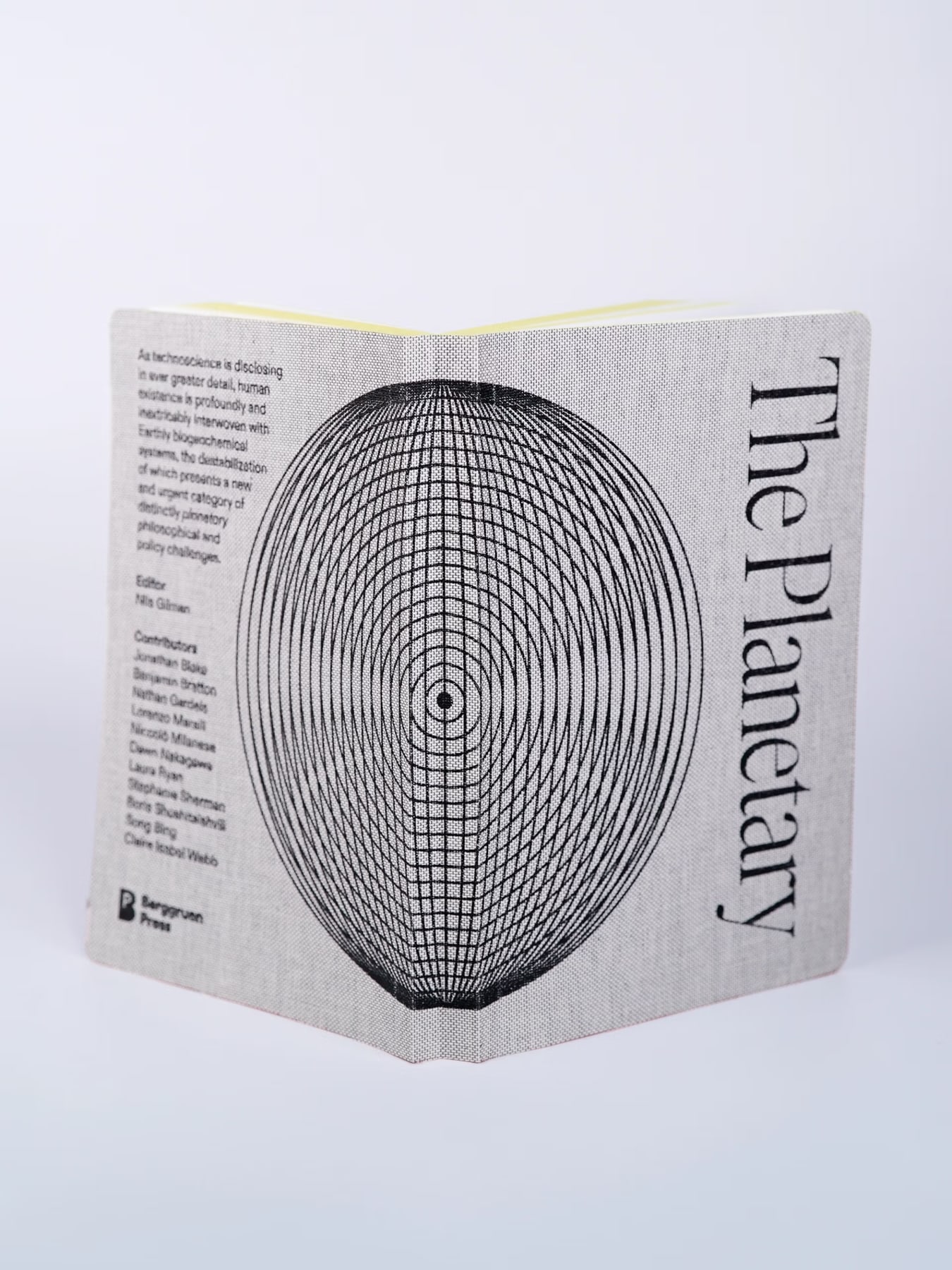
The Planetary
- By
- Nils Gilman (ed.)
- Design
- not recorded
- Published
- DOI
- none
- Length
- ~46k words
- Original
- Read the original
Summary#
The Planetary (Berggruen Press, 2024) is an edited collection of eleven essays that sets out the Berggruen Institute's account of "the Planetary" as a technoscientific object, a philosophical event, and a governance problem. Nils Gilman's introduction supplies the organizing term, the condition of planetarity: the fact, only recently made visible by planet-scale instruments, that humans are embedded in an Earth-spanning biogeochemical system they can neither leave nor stand outside of. Part I (Bratton, Webb, Sherman) describes the sensing and computing apparatus that disclosed this condition and asks what it should now be used for. Part II (Milanese, Shoshitaishvili, Song) treats the disclosure as a break in philosophy, in how time, the human, and the individual are conceived. Part III (Nakagawa and Ryan, Blake, Marsili) and Nathan Gardels's conclusion propose new political subjects, new multiscalar institutions, and a working method for building them without a world state. The volume matters for the Antikythera corpus because Bratton's planetary sapience and Sherman's platform automation sit here next to a policy program that takes them as premises, and because the contributors disagree openly about whether governance is a matter of institutions or of cybernetics.
The argument#
Gilman frames the book with a distinction between the global and the Planetary. Globalization named the movement of human things across borders; the Planetary names what crosses borders without regard to human intention: the carbon cycle, zoonotic viruses, biodiversity loss, orbital debris. Following Nathan Gardels, he puts it as "borders crossing us." The condition of planetarity is revealed by the concept's elaboration, the intensification of anthropogenic effects, and a technological exoskeleton able to sense them. He borrows "condition" from Harvey's The Condition of Postmodernity and from Kant's conditions of possibility to insist that this is not a new frame but an ontological fact that has always held and has now been disclosed. From it he draws a political-ethical rule: institutions should promote habitability, the continuity of the whole web of life, rather than sustainability, which treats nature as a stock to be managed for human use.
Gilman also names a schism inside planetary thought and takes a side. One episteme, descending from Gayatri Spivak's coinage of "planetarity," treats the planet as unknowable, suspects satellite views and computational models of continuing colonial enclosure, and refuses custodianship. The other, which Gilman associates with Bratton and Sherman in this volume, treats the condition of planetarity as a design space and holds that the problems technoscience produced can only be fixed by better technoscience. He warns against reading the Planetary as a successor ideology to globalism, since one cannot be for or against an ontological condition.
Part I is about the apparatus of disclosure. Bratton argues that planetary-scale computation is an epistemological technology in Lem's sense: its main effect is to reveal, and what it revealed is that the terraforming of Earth was already underway before anyone could see it. The task is to make terraforming deliberate. Webb shows that the same technologies of perception, turned outward, have unmoored habitability from Earth-like conditions, and that Earth becomes one case of the planetary rather than its definition. Sherman argues that Earth is already an automated platform and that governance should be understood as the design of operations without operators.
Part II takes the disclosure as a philosophical event. Milanese argues, against Chakrabarty, that deep time does not break history; a counterfactual theory of causation can narrate human and nonhuman actors together, and what needs replacing is the tragic plot and the sovereigntist conception of politics. Shoshitaishvili reads Vernadsky, Lovelock and Margulis, and the Anthropocene as three encounters with the planet as an other that also names what humans are: noosphere, planetary body, planetary force. Song Bing offers gongsheng/kyōsei, co-becoming, from Confucian, Daoist, and Buddhist sources as a relational ontology the sciences of symbiosis now corroborate.
Part III and the conclusion propose the response. Nakagawa and Ryan describe a planetary constituent, a political subject whose first loyalty is to reversing planetary damage, and argue the nation-state cannot give it agency. Blake supplies the institutional principle, planetary subsidiarity: allocate authority to whatever scale governs a function best and adjudicate the allocation through a subsidiarity assembly. Marsili supplies the method, planetary pragmatism: no new grounding, no heroic founding, but a web of concrete universals that "befit the moment." Gardels closes with planetary realism, realism about interdependence joined to realism about a world still made of sovereign states.
The disagreements are structural rather than incidental. Bratton and Sherman hold that governance is cybernetic, the process by which a system senses, models, and acts on itself, and that imagining planetary governance as an arrangement of representatives is an "extra-large-scale caricature" of national politics. Blake and Nakagawa and Ryan propose exactly such arrangements: a Planetary Atmospheric Steward, a subsidiarity assembly, procedural representation for nonhumans. Blake concedes in a footnote that Sherman's technologies may change which scale governs best, but the two accounts of what governance is are not reconciled. Sherman regards Darwinian selection as locally intelligent and globally "stupid," and wants automation to accelerate evolution; Song's co-becoming recommends "a slower but steadier developmental trajectory" and the virtues of modesty and self-restraint. Milanese insists politics remains a human responsibility, while Sherman's "operations without operators" removes the operator by design. Gilman rejects the Spivakian episteme; Shoshitaishvili treats Spivak's two formulations of alterity as the source of the volume's metaphysics. Nakagawa and Ryan cite polling to show a growing planetary constituency; Gardels reports a "greenlash" and concludes that climate mitigation has "a limited constituency" in democracies and autocracies alike.
Section by section#
Preface (Nicolas Berggruen)#
Berggruen presents the volume as the seed of "a new school of thought" around Gilman's condition of planetarity and summarizes the three parts in a paragraph each. He borrows Arendt's vita activa for Part III and admits that its governance proposals "may seem wild, perhaps even utopian," and that the world today is moving in the opposite direction. His stated measure of success is linguistic: if people come to say "planetary challenges" as naturally as they began saying "global challenges" in the 1990s, the book will have worked.
The Condition of Planetarity (Nils Gilman)#
Gilman's introduction is the book's argument in miniature and its glossary. As a technoscientific object, the Planetary is the totality of Earth-scale biogeochemical systems, a holism with antecedents in Humboldt's Naturgemälde but made operational by the "megastructure of sensors, networks, and supercomputers" that Bratton calls planetary sapience. As a philosophical irruption, it is a decentering deeper than Copernicus or Darwin: it dissolves the monadic individual (we are multispecies assemblages), exposes the limits of direct experience of space and time, and, drawing on Rovelli's relational physics, replaces alterity with relationality. As a political category it is defined against the global, and Gilman uses Tooze's polycrisis as the name for what happens "in the shadow of the Planetary."
The section on the condition itself does the conceptual work. Gilman traces "condition" through Lyotard and Harvey to Kant's Bedingungen der Möglichkeit: a condition does not cause events but sets the terms within which they can occur. Earth is that frame; "there is no Planet B." He then turns Arendt against herself. The Human Condition treated the terrestrial as the stable backdrop to the human drama; the Anthropocene collapses her distinction between self-made and natural conditions, and, in Latour's phrase, the stage itself has become unstable. A footnote separates "planetary conditions" (the biogeochemical facts) from "the condition of planetarity" (the reflection those facts provoke).
The "Two Epistemes" section is where Gilman argues rather than defines. The Spivakian line, documented through Bendik-Keymer, Gabrys, DeLoughrey, and Catherine Keller, treats the unified planet as a colonial artifact and demands "a prayer for planetarity" in place of formulaic access. Gilman quotes Holmes on William James, who "turn[ed] down the lights so as to give miracle a chance," and answers that "modesty should not be allowed to deliquesce into despair." His counter-position, that the solution to technoscience's problems "is (and can only be) more and better technoscience," is hedged against techno-solutionism but not withdrawn; Frank, Walker, and Grinspoon's mature technosphere and Stewart Brand's ecopragmatism are its models. A long footnote refuses the "ecologically noble savage" and denies that any tradition holds a golden key for eight billion humans, which sits awkwardly beside the volume's appeal to East Asian thought in Song's chapter.
The governance section sets up Part III. Gilman quotes Giddens in 1990 already imagining "planetary care" on the Gaia model, contrasts habitability with the UN's sustainability paradigm, and states two requirements: a politics that includes the nonhuman (he cites Donaldson and Kymlicka on animal language) and a politics that exceeds the nation-state. He closes with the German idiom Flucht nach vorne, a flight forward, as the only available option.
Planetary Sapience (Benjamin Bratton)#
Bratton's chapter is a reworked version of his 2021 Noema essay of the same name, reorganized under new headings and with one new section; the notes on that essay cover the argument in full and this entry records what the book version emphasizes. It opens with the Blue Marble as a movie: 4.5 billion years compressed, with satellites and cables sprouting in the final frames as "an intricate artificial planetary crust." Planetary-scale computation is a geological event, an "intelligent exoskeleton" through which Earth can calculate its own age and temperature, and the knowledge of climate change is "an epistemological accomplishment" of that computation.
Three terraformings follow: the one humans were born into, the one that continues regardless, and the deliberate one that is now possible. Since the Anthropocene was underway centuries before computation made it perceivable, "agency precedes subjectivity," and the third terraforming is the project of the subjectivity that arrived late. Bratton distinguishes an astronomical planetarity from a political-philosophical one and insists the second must be built from the first; here he "extend[s] and depart[s] from" Spivak by refusing her subordination of the quantitative to the qualitative. Vernadsky's geological noosphere is preferred to Teilhard's theological one: planets think through the life they evolve.
The "Politics and Governance" section is new to the book and is the part most relevant to the rest of the volume. Bratton separates the Political, in Schmitt's sense of agonistic contestation over symbols, from governance, "the process by which a complex system is able to sense itself, model itself in the present and future, and to recursively act back upon itself." Planetary computation has decoupled the two, leaving the Political "to float in the clouds of its own semiotic exhaust" while platforms do the work. The question of agency is therefore not who is sovereign first-mover but "what should be the architecture of relays," and imagining planetary governance as an arrangement of people and representational processes reduces it to a caricature of national politics. The remaining sections restate the ecological theory of automation (automation caused globalization, not the reverse), the Simon-derived distinction between artificial and synthetic intelligence with AlphaGo's move 37 and Sedol's move 78 as the example of synthesis, and the "unpayable debt" of an intelligence whose emergence caused the precarity it must now solve.
Extraplanetary Conditions (Claire Isabel Webb)#
Webb's chapter turns the technologies of perception outward. She begins with Earthrise on Christmas Eve 1968 and Anders's remark that "the most important thing is that we discovered the Earth," and defines technologies of perception as the assemblages of instruments and computation that disclose Earth's materiality and thereby change how humans see themselves. Habitability is the fulcrum: from the Greek oikoumene onward it meant what is fit for humans, with Earth as the reference. Telescopes, probes, and simulations are now dislodging that reference.
The historical sections make two moves. First, the Space Age produced a doubled fragility. Aronowsky's reading of the Apollo capsule as an ark shows how thin the border between planetary and extraplanetary was, and Lederberg's contamination protocols (screw threads, quarantine, the 1964 Space Science Board warning that an innocuous organism might "overgrow terrestrial life forms") made Earth a precious object in relation to other possible sites of life. Webb notes it is no coincidence that environmentalism followed the Space Age. Second, the habitable zone has given way to habitability without Earth-likeness: Europa's subsurface ocean, Titan's methane lakes and its cyclopropenylidene, Hycean worlds, and climate models stretched to red-dwarf systems where black plants might absorb near-infrared light. Astrobiologists, following Messeri, "make planets places" by analogy (Lake Vostok for Europa's ice, Ontario Lacus for Namibia's Etosha Pan), a double epistemic act of welcoming familiarity and seeking alienness.
Biosphere 2 is her closing case. The 1990s Arizona greenhouse was meant to model a Martian settlement and instead demonstrated permeability: oxygen leaked, pollinators died, cooperation failed. Webb calls the lesson "gaiamorphization," rediscovering ourselves inside a simulated Earth. Her conclusion inverts Gilman's framing: "Rather than define the planetary, Earth has transformed into a subsidiary of it," and a new episteme of life, mind, and outer space follows.
Planetary Platform Automation (Stephanie Sherman)#
Sherman starts from Buckminster Fuller's Operating Manual for Spaceship Earth and its "comprehensively commanded automation." Fuller parsed automation three ways, as physical principle, as socio-technical delegation, and as planetary protocol, and Sherman adopts all three: "Earth is, and has always been, an automated platform." Platforms are given a geological definition first (a plane of rock filled to a smooth base) and then generalized: a chassis in synthetic biology, an oil rig, a rail standard, a digital exchange, the Square Kilometre Array. Platforms accelerate automation by embedding decisions into environments so they no longer need to be considered.
Her redefinition of automation departs from labor substitution. Automation is "the continued process of resolving questions embedded in decisions or context," and evolution itself automates by discovering structures through encounter rather than programming from first principles. Intelligence, on this account, is not awareness, metacognition, or consciousness but "functional operational behavior by which systems continuously learn and revise themselves according to feedback." The highest intelligence is "involuntary virtuosity," performance that no longer requires cognitive effort, and humans become developers rather than programmers of platform automation. The target is "operations without operators."
The section on Gaia and evolution is where the chapter's normative edge shows. Gaia theory, she says, rests on the Holocene's temporary stability; the Great Oxidation Event shows that platform automation proceeds by rupture as well as iteration. Natural selection is "energetically intelligent at a local level, but not necessarily intelligent from a whole-systems view," and she cites Yudkowsky's "evolutions are stupid" for a process whose optimizations cannot see their cascades. The automobile-highway system is her example of autopoietic automation encoding fossil-fuel dependence. From this she argues for the cybernetic governor over the political one, reframes algorithmic governance "from threat to opportunity" against Danaher's "algocracy," and proposes a mechanism in which carbon output automatically sets price.
The closing section on operational intelligence uses the strategy game Stellaris, whose automated planetary administration players find incompetent, to argue that existing models predict from past parameters without updating on outcomes. Operational intelligence must cross-check feedback loops across planetary systems and process predictions in parallel rather than in von Neumann sequence. The Montreal Protocol is her one example of planetary policy gone right, and an Independence Day-scale emergency her alternative trigger. She ends by calling the current obsession with governing AI an irony, when AI should be deployed as a tool for governance.
Planetary Deep Time and Human Autonomy (Niccolò Milanese)#
Milanese opens with Eliot's "human kind / Cannot bear very much reality" and describes the Planetary as a disorienting event with two faces: it centers humans as the cause of destabilized Earth systems and decenters them entirely in timescales without them. Chakrabarty calls the result a "crisis of temporal management" rooted in history's dependence on human experience. Milanese denies that diagnosis.
His resource is Ricoeur's Time and Narrative. Aristotelian cosmic time and Augustinian experienced time complete and occlude each other, and history mediates between them through a triple mimesis: prefiguring action as intentional, emplotting events, and refiguring the story in a reader who then acts. Three problems seem to block this for planetary history: timescales beyond experience, humankind as a collective actor, and nonhuman actors. Milanese answers all three through philosophy of science. Von Wright's split between law-like explanation in nature and hermeneutic understanding in the human sciences would make the break unbridgeable, but biology explains without laws. Woodward's interventionist account defines a cause counterfactually: X caused Y if Y would not have occurred without X. Because interventions can be made by nonhuman and nonsentient actors, planetary history can include human and nonhuman actants "with the same causal structure," and because it requires imagination and as-if agency, it already performs Ricoeur's mimesis. Neither humans nor planets need to be humanized or mechanized. Politics remains "clearly a human responsibility."
The real problem, he concludes, is politics, not history. Western politics still runs on Christian symbols of sovereignty, and the Planetary undermines its pretense to self-sufficiency. Worse, the tendency is to read the revelation as tragedy, an Oedipal anagnorisis in which past, present, and future collapse into an intolerable now and the only responses are inaction, madness, or denial. Milanese proposes metamorphosis as the replacement archetype: multivocal, multitemporal, without definitive start or end, able to hold urgent and long horizons at once. Against Chakrabarty, the task is not to tame the planet's alterity but to act while embracing it.
Planetary Metaphysics (Boris Shoshitaishvili)#
Shoshitaishvili begins with Vernadsky's 1938 division of the sciences into the universal and the planetary, which placed the humanities on the planetary side. He then finds his organizing device in a textual variant of Spivak. Her 1997 lecture said the planet belongs to another system "and yet we inhabit, indeed are it"; the later published version reads "and yet we inhabit it, on loan." The two versions imply two metaphysics and two ethics. The planet as loaned dwelling yields stewardship. The planet as what we are yields a peer to be faced, and Shoshitaishvili brings in Levinas, for whom comprehension of the other is inseparable from invocation, to ask what the planet's face is and how one speaks with it.
Three scientific encounters answer. Suess's The Face of the Earth and Vernadsky's Biosphere imagined the planet seen from space decades before photography and found in the biosphere a living face; from that vantage Vernadsky, Teilhard, and Le Roy named humans a planetary sphere, the noosphere. Lovelock and Margulis, looking back from Mars, read Earth's oxygen atmosphere as evidence of a self-regulating body; Teilhard, James Miller, and Gregory Stock then treated trade, technology, and pandemics as signs that humans form a second Earth-spanning body, Gaia's peer, so that Earth may be "doubly alive." Williams, Zalasiewicz, and Milon name that body a Leviathan, a child of Gaia large enough to menace its parent. The Anthropocene, finally, makes geologists think from the deep future toward the present and casts humans as a planetary "force." Shoshitaishvili notes that "force" carries an older, disruptive sense, the divine force of the Flood, alongside Newton's ordering forces, and that tipping-point thinking now turns this disruptiveness back on human systems as "social tipping points." He records that the Anthropocene epoch was voted down in 2024 and closes with the etymology that links "human" to humus: Earth is already our species' name.
Co-Becoming: A Planetary View Inspired by East Asian Philosophies (Song Bing)#
Song's target is methodological individualism, which she traces from Hobbes's "congeries of colliding atoms" through Locke, Smith, Mill, Hayek, and Friedman to the institutions of neoliberal economics, liberal democracy, and meritocratic education. She grants that these institutions produced the fastest material improvement in history and charges them with the loneliness, consumerism, and divisiveness of recent decades. Her alternative is gongsheng (Chinese) or kyōsei (Japanese), written with the same characters 共生, which she translates as co-becoming: a world of "mutually embedded, coexistent, and co-generating entities." The compound appears after the Qin period; modern usage began in Japan in the 1980s, probably under the influence of symbiosis research, and spread to Chinese discourse around 2000. She chooses "becoming" over "being" to register ceaseless change as the first cosmic rule.
Four propositions supply the philosophical sources. The "unity of tian and humans," imperial doctrine by the Han, places humans as one creation among many, primordially related to heaven and earth. The "oneness of all beings" is developed through Zhang Zai's line that "all people are my brothers and sisters, and all things are my companions," grounded in qi as the common animating substance, and through Wang Yangming's claim that the innate knowing of humans is also that of "plants, trees, tiles, and stones." Shengsheng, "ceaseless living and generating," from the Book of Changes, is the creative force immanent in all things. Buddhist co-dependent origination holds that nothing except nirvana is independent.
Song then argues that biology has caught up: holobionts and symbiogenesis show that no unit exists in isolation, and she quotes Kobayashi that kyōsei is "a mundane, prosaic 'fact'" rather than a metaphysical truth. Contemporary East Asian philosophers extend this without discarding the individual. Deguchi's "we-turn" treats the "I" as a partial multi-agent system; Sun Xiangchen's "double ontologies" define the human as a family-situated individual. The ethical consequences she draws are the rejection of zero-sum thinking and the maximization ethos, the reframing of competition as collective learning, "companionship" with nonhumans, and a preference for modesty and self-restraint. Her last sentence promises "a slower but steadier developmental trajectory," which is not the tempo the volume's first part recommends.
The Planetary Constituent (Dawn Nakagawa and Laura Ryan)#
Nakagawa and Ryan identify a new political subject, the planetary constituent: people "whose primary political motivations lie in reversing human-caused damage to the planet." Its origin is the double realization of embeddedness and damage. The microbiome is the chapter's emblem of the first; the 2012 discovery that the body hosts 100 trillion microbial cells makes the human a holobiont, "one voice in a grand chorus." The planetary-scale technostructure discloses the second. Their formula for the resulting "we" is "we the living things," as against the nation-state's "we the people."
The chapter's political history runs from the 17th-century nation-state and its sovereign self-interest through liberalism's monadic individual, homo economicus, and the citizen as a category of exclusion, to late-20th-century cosmopolitanism (Nussbaum, Pogge), which expanded the human "we" but kept nonhumans outside. Planetary constituents remain citizens; the claim is not that the state will end but that it cannot supply the agency they seek. The evidence offered for the constituent's existence is a list: vegan thrift shoppers, the Global Covenant of Mayors, the Mutehekau Shipu river's legal personhood in 2021, Fridays for the Future's 2019 strikes in 131 countries, the Lancet's finding that 60 percent of 16-to-25-year-olds are very or extremely worried about climate change, and youth climate lawsuits. Citing Blake and Gilman's Children of a Modest Star, they hold that national governments are structurally incapable of solving planetary crises.
Their sketch of new institutions has four adjectives. Local: jurisdiction should follow the system being protected, a watershed rather than a border, with digital platforms enabling trans-local networks. Plural: following Connolly's Facing the Planetary, a "pluralist assemblage" that extends to the more-than-human, with appointed human experts and protective agencies as the current best means of representing it. Scientific and pragmatic: the constituent's "unifying truth is science," and Connolly's entangled humanism and Marsili's planetary pragmatism supply the governing ethos. They close by warning that state failure "incubates fascist, hyper-nationalistic politics."
Planetary Subsidiarity (Jonathan Blake)#
Blake's chapter, drawn from Children of a Modest Star, is the volume's institutional design. Planetary challenges manifest across scales from the microscopic to the exospheric, and the national state, whose authority stops at its border, is "structurally incapable" of acting at planetary scale and, citing Zhao Tingyang, conceptually limiting. He proposes a single worldwide governance architecture that is not a world state: authority distributed to the level "where decisionmaking is most effective for governing the task at hand," with institutions from the planetary (a Planetary Atmospheric Steward with authority to limit emissions) to the hyperlocal.
Planetary subsidiarity is the allocation rule. Subsidiarity, in four centuries of European thought, holds that larger units should not act where smaller ones can; Blake applies it to the twin goals of habitability and multispecies flourishing, the latter defined not sentimentally but as the recognition that human flourishing depends on other species. Four features follow. Form follows function: habitat restoration is local, redistribution national, carbon management and pandemic risk planetary, and no single scale fits all. New institutions are needed above and below the state, with warrant from both EU practice and the Catholic tradition of John XXIII's Pacem in Terris. Duties run in all directions, so larger scales must assist smaller ones (the Latin subsidium means assistance) without stripping self-governance. And the preference for the local is a deliberate check that keeps planetary institutions "minimally viable" and prevents a general-purpose world government.
The fourth feature, that allocations are not permanent, produces the chapter's most concrete proposal. A subsidiarity assembly, adapted from Trevor Latimer, holds the system's meta-authority: it decides which unit has the right to decide, not what to decide. It sits outside the multiscalar architecture, includes representatives from every scale plus subject experts, convenes perhaps once a decade with a standing secretariat for petitions and emergencies, and is biased toward the status quo for stability. Blake notes that the current order has no meta-authority beyond each sovereign state and, following Zürn, treats that absence as its legitimacy problem. A footnote grants that Sherman's technologies may alter which scale governs best; the body of the chapter does not take up her cybernetic alternative.
Planetary Pragmatism (Lorenzo Marsili)#
Marsili opens with a scenario: at the ceremony sealing a global AI treaty, every screen goes dark and then displays "No regulation without representation." The point is that an assembly that thought itself universal is revealed as provincial, and that this provincialization is already underway through the end of "300 years of Western domination over humanity and of humanity's domination over the planet." He reads that end as a geopolitical enlightenment in Kant's sense, the release of peoples from Western tutelage, and notes the parallel provincialization of the human by an Earth that now constrains it.
The problem is Levinas's warning that a "saraband of innumerable and equivalent cultures" leaves a world désoccidentalisé and therefore désorienté, in which only power remains. Marsili refuses both horns of the resulting dilemma: relativist multipolarity drifting toward indifference or "low-intensity planetary civil war," and a new grounding imposed after a cataclysm, as the UN and Bretton Woods followed two world wars. He calls the second "a perverse kind of geopolitical Platonism," the belief that only the One can order the world.
Classical Chinese philosophy supplies a third position. Chinese thought, he argues, never got stuck between truth and opinion; the mean is not Aristotle's midpoint but an energeia, the capacity to shift as the situation requires, and action is guided by what "resonates with the cosmos and befits the moment." Confucius's rectification of names adapts words to social harmony rather than to a thing-in-itself, so a universal needs not unanimity but "a contingently defined enough of the world." Foucault's specific intellectual, exemplified by Oppenheimer, whose localized relation to nuclear knowledge let him speak universally, is the model for planetary norms that are universal in their domain and dependent on contemporary reality.
Planetary pragmatism is therefore "the gradual development of a web of concrete and specific practices, policies, and institutions of universal scope." Against the WHO constitution's grand and inapplicable right to health, Marsili proposes a planetary guarantee of pandemic equipment and a pandemic research center; against abstract solidarity, a planetary civil protection force on the model of Gorbachev's Green Cross. The sense of shared destiny follows construction rather than preceding it. He closes with Marco Polo's answer to Kublai Khan in Calvino: find what in the inferno is not inferno, make it endure, give it space.
Planetary Realism (Nathan Gardels)#
Gardels's conclusion gives planetarity three aspects. Planetary reason is the awareness that humans are one part of a self-regulating system of multiple intelligences, a non-human-centric logos disclosed, as Bratton argues, only when intelligence is scaled into distributed artificial systems. Planetary time is Mbembe's simultaneity, in which "human history and Earth history are now indivisible," and Sloterdijk's observation that cultures with separate pasts now face a common future. Planetary realism is the practical manifestation of both.
The term is Jerry Brown's. Gardels quotes Brown's account of coining it in 1976 to combine the realism of Morgenthau, Machiavelli, and Kissinger with "a dose of humanism," under the influence of the 1972 Stockholm Conference, with the sea and nuclear war rather than climate in view. Gorbachev's "new thinking" about interdependence and his Green Cross International, which Gardels advised, are the second lineage. Gardels calls the successor to realpolitik "Gaiapolitik."
The middle section is the volume's most sober. Politics and culture "have a different logic" from science, and when they meet they clash. The planetary imperative of mitigation has become "the province of renewed nationalism": the Inflation Reduction Act and the European Green Deal compete by subsidy and tariff against China's green-technology lead, and global warming has been weaponized in a new Cold War. A greenlash driven by resentment of "Tesla-driving elites" and the uneven costs of transition has ended what he calls the environmentalists' "Diet-Coke imaginary." Planetary realism therefore has a double meaning: realism about interdependence, and realism about a world of nations committed to sovereignty. The practical cases are a US-China "partnership of rivals" on climate and California's direct agreements with China under Brown and then Newsom's 2023 meeting with Xi ("Divorce is not an option"); in Blake's phrase, "translocalism circumnavigates geopolitics." Governance, he says with Blake and Nakagawa and Ryan, will be distributed like natural systems rather than centered at the global level.
The final section draws on Woodrow Wilson's organicism ("accountable to Darwin, not to Newton") and reads the League of Nations' failure as Wilson's failure to heed his own insight: universal alignment cannot come from a foundational event at a palace outside Paris but only from responding "one tangible step at a time" to shared challenges. This is Marsili's conclusion in a different idiom.
Companion Readings#
An unannotated bibliography of roughly a hundred works, from Humboldt and Vernadsky through Chakrabarty, Connolly, Latour, Lovelock, and Spivak to Bratton's The Stack, Likavčan's comparative planetology, Moynihan's X-Risk, Frank, Grinspoon, and Walker's "Intelligence as a Planetary Scale Process," and fiction by Robinson and Watts. It shows how much the Berggruen and Antikythera reading lists overlap, and ends with an epigraph from Achille Mbembe: "Maybe the first step is to listen."
Key concepts#
- The Planetary — Gilman's tripartite term: an Earth-scale biogeochemical totality (technoscientific object), a decentering deeper than Copernicus or Darwin (philosophical event), and a category defined against the global by what crosses borders without human intention (political category).
- Condition of planetarity — The inescapable embeddedness of humans in Earth's biogeochemical feedback systems, an ontological fact that has always held and that planet-scale sensing has recently disclosed. Gilman distinguishes it from "planetary conditions," the facts themselves, and models the phrase on Harvey and Kant.
- Two epistemes of planetarity — Gilman's schism: the Spivakian view of the planet as unknowable and of totalizing models as colonial, versus the technoscientific view of the condition as a design space for action.
- Habitability (versus sustainability) — The volume's political-ethical goal, taken from Webb: the continuity of the web of life in which humans are embedded, as against sustainability's management of nature as a standing reserve. Blake pairs it with multispecies flourishing.
- Planetary sapience — Bratton's term for the planet's self-representation through the computational exoskeleton it has evolved; see Planetary Computation, Terraforming (of Earth), and Viable Planetarity.
- Epistemological technology — Bratton's Lem-derived category for a technology whose main effect is what it reveals; planetary computation revealed the terraforming already underway, so that agency precedes subjectivity.
- Synthetic Intelligence — Simon's distinction applied to AI: the artificial merely resembles, the synthetic genuinely is; also the synthesis of human and machine intelligence, as in the AlphaGo match.
- Technologies of (extra)planetary perception — Webb's term for the instrument-and-computation assemblages that disclose Earth's materiality and, turned outward, unmoor habitability from Earth-like conditions; see Technologies of Perception.
- Platform Automation — Sherman's double term: the automation of platforms and the platformation of automation. Earth is already an automated platform.
- Operational intelligence — Sherman's account of intelligence as functional behavior that revises itself on feedback rather than as awareness or consciousness; its ideal is "operations without operators" and "involuntary virtuosity."
- Metamorphosis (versus tragedy) — Milanese's proposed narrative archetype for planetary politics, replacing the Oedipal plot that produces guilt and paralysis.
- Planet as dwelling / planet as what we are — Shoshitaishvili's two metaphysics, drawn from two versions of a Spivak sentence, yielding an ethics of stewardship and an ethics of facing a peer.
- Noösphere — For Shoshitaishvili, the first scientific naming of humans as a planetary sphere, arrived at by facing the biosphere, and the ancestor of the "doubly alive" Leviathan (see Superorganism); for Bratton, Vernadsky's geological version wins over Teilhard's.
- Co-becoming (gongsheng/kyōsei, 共生) — Song's relational ontology of mutually embedded, co-generating entities, sourced from the unity of tian and humans, the oneness of all beings, shengsheng, and co-dependent origination, and corroborated by symbiogenesis.
- Planetary constituent — Nakagawa and Ryan's political subject whose primary loyalty is to reversing planetary damage; "we the living things."
- Planetary subsidiarity — Blake's rule for allocating authority to the scale that governs a function best in service of habitability and multispecies flourishing, with the subsidiarity assembly as holder of meta-authority.
- Planetary pragmatism — Marsili's method: concrete universals that "befit the moment," accumulated without a new grounding or a founding event.
- Planetary realism — Jerry Brown's 1976 coinage as Gardels develops it: realism about interdependence joined to realism about a world of sovereign states; successor to realpolitik as "Gaiapolitik."
- Politics versus governance — Bratton's Schmittian distinction between agonistic contestation over symbols and the cybernetic self-sensing and self-correction of a system; see Recursive Governance and, for the threshold Gilman and Sherman both cite, Mature technosphere.
Connections#
Bratton's chapter reprints Planetary Sapience with a new "Politics and Governance" section, and readers should treat that note as primary for the rest. The term's later development is in the Planetary Sapience Symposium, where Sherman and Moynihan also appear, and in Antikythera, whose "accidental terraforming" and agency-precedes-subjectivity formula are restated here. Speculative Philosophy of Planetary Computation and A New Philosophy Of Planetary Computation give the fuller account of computation as epistemological technology.
Sherman's chapter is the abstract statement of the argument that AUTO– makes through the automobile, and the journal's glossary definition of platform automation matches this chapter word for word. Her preference for the cybernetic governor over the political one agrees with Bratton and with After Alignment's critique of regulatory solutionism, and it is in tension with Blake's institutional proposals in the same volume.
Webb's extension of habitability beyond Earth-likeness agrees with The Long L, where Likavčan argues that habitability means enhancing a planet's genesity rather than conserving a baseline, and her claim that Earth is a "subsidiary" of the planetary matches Likavčan's comparative planetology. Her "technologies of perception" is the term Sara Walker borrows in Recursive Worlds. Substrates Unbound shares her interest in how instruments and simulations redraw the natural-artificial line, though Tripaldi's substrate agency has no counterpart here.
Shoshitaishvili's lineage runs through works the corpus holds directly: The Transition from the Biosphere to the Noösphere is the Vernadsky text he reads, and his "doubly alive" Leviathan is the same archive Moynihan works in Planetary Sapience & Planetary Stupidity and Are We Accidentally Building a Planetary Brain?, where the superorganism's totalitarian shadow gets more weight than it does here. Moynihan's Noema essay also cites planetary subsidiarity as the middle ground between chaos and world government, the only place outside this book where the corpus engages Blake's term.
Milanese's argument about deep time and narrative runs alongside The History of Now, which treats the same disorientation as a history of numerical estimates rather than of plots; both reject the conclusion that bounded deep time paralyzes action, Moynihan on the ground that only bounded time makes decisions consequential, Milanese on the ground that the counterfactual theory of causation keeps history unitary.
Song's co-becoming agrees with the symbiogenesis thread in What Is Intelligence? and the journal's Symbiogenesis entry on the point that individuals are late and partial, but its ethics of restraint runs against Bratton's and Sherman's acceleration, and Gilman's refusal of any tradition as a "golden key" sits beside it uneasily.
Part III's diagnosis of the nation-state is the Berggruen counterpart to The Stack's nomos of the Cloud: both hold that Westphalian sovereignty cannot contain planetary-scale processes, but The Stack locates the successor in infrastructural platform sovereignty while Blake locates it in designed institutions and a meta-authority. Gardels's scenes of climate nationalism and US-China rivalry are the non-fictional version of the futures rendered in Hemispherical Stacks, especially Gilman's own Climate Leviathan, where China wins the transition by bundling technology with governance. Existential Technologies supplies the Lem vocabulary Bratton uses for computation's revelatory function.