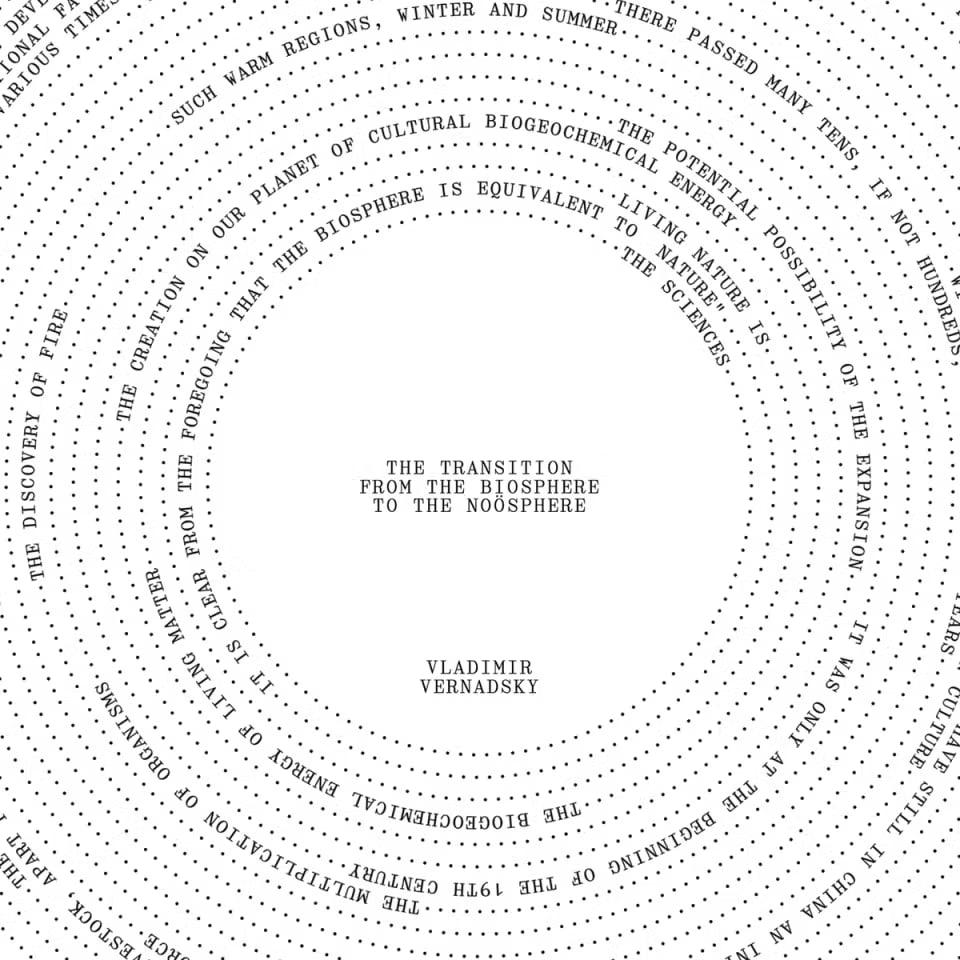
The Transition from the Biosphere to the Noösphere
- Design
- GIGA
- Published
- DOI
- 10.1162/ANTI.5CZD
- Length
- ~12k words
- Original
- Read the original
The noösphere is a new planetary layer emerging from the combined cognitive agency of humans and the technical infrastructures they build.
Summary#
Vladimir Vernadsky (1863–1945), the Russian-Ukrainian mineralogist who gave the term "biosphere" its modern scientific meaning, argues in this text that humanity has become a geological force and that the biosphere is passing into a new state he calls the noösphere, the sphere of reason. The mechanism is not a better brain but a new kind of energy: "cultural biogeochemical energy," the energy of human societies directed by reason, which now moves more matter around the planet than ordinary biological activity does. The text is an excerpt, numbered sections 100 to 119, from a larger unfinished book; the internal references ("I will return to this later in the book", a 1938 issue of Nature, "more than 20 years" since calculations made in 1917–1919) place its composition in the late 1930s, and it was published in Russian only posthumously. Antikythera republished it in the journal's first issue (May 2025) with a new design by the studio GIGA. Benjamin Bratton describes it as one of the "classical pieces" the journal is redesigning alongside Turing, because Vernadsky's work "begins the idea of understanding the evolution of intelligence as a geologic phenomenon." It is the earliest source in the corpus for the claim that thought is a planetary process with a material history.
The argument#
Vernadsky begins from a claim about the sciences rather than about humanity. Every science that is "most accessible" to human thought, from botany and geology to the humanities and the technical sciences, is a science of the biosphere, and even the sciences of cognition (the brain, the sense organs, psychology, logic) can be treated "as a geological factor," because thought is what has transformed the biosphere into something new. The biosphere is therefore what the naturalist means by "nature," and it is not formless: it has a definite structure, which a footnote glosses as dynamic, never returning to a previous equilibrium, closer to an organism than a mechanism, and best described as an "organization."
What distinguishes the biosphere from the Earth's other envelopes is life, and what distinguishes life is that it alone creates and carries free energy. Vernadsky calls this biogeochemical energy. It is expressed primarily through reproduction, respiration, and nutrition, and it drives the migration of chemical elements through the planet's outer shell; the example he returns to is magnesium passing through chlorophyll in an unbroken chain of green organisms for at least two billion years. This first form of energy is a fixed "species characteristic," the same for humans as for any other organism.
The argument's central move is the identification of a second form. Within the last ten thousand years a new kind of biogeochemical energy has appeared, "associated with the vital activities of human societies," which Vernadsky names cultural biogeochemical energy. It exists in trace amounts in any organism with a nervous system, in nest-building and the displacement of other species, but it is negligible in the balance of nature until the appearance of reason. In humans it grows, and its growth is social rather than neural. Paleolithic skulls show no structural difference from modern ones, so reason must be "a complex social structure, erected … on the same neural substrate, but in different social circumstances," and its growth comes above all from scientific knowledge. This is the energy that is "at the present time" creating the noösphere.
The remainder of the excerpt is evidence and history. Vernadsky establishes that reproduction is in principle capable of spreading any species across the whole planet (the law of geometric progression), that humans are now actually doing so, and that the energy available to reason is, with nuclear power, "practically unlimited," though bounded by the dimensions of the biosphere and by the speed at which life can be transmitted. He then reconstructs the stages by which cultural energy accumulated: fire, the first time a living organism mastered a force of nature; agriculture and livestock, the true geological force because they destroy old life and create new life across a quarter of the planet's surface; and the acceleration from the first cities through writing, printing, steam, electricity, and flight, until "the entire surface of the planet was embraced by a single culture." The present, he says, is a transitional stage in which "a planned unified activity for the mastery of nature and a just distribution of wealth" has become "the order of the day." The process is irreversible and "elemental."
The excerpt closes with a reflection on what kind of science can describe this. Vernadsky insists that everything above is empirical generalization "without the assumption of any hypotheses, theories or extrapolations." He distinguishes sciences whose objects are universal (physics, chemistry, mathematics, astronomy) from sciences whose objects are terrestrial (biology, geology, the humanities), places logic among planetary phenomena, and admits that scientific creativity and art exceed what logic can capture. The final section asks whether biogeochemistry, because it rests on the atom, reaches beyond the planet, and leaves the question open.
Section by section#
Sections 100 and 101: the biosphere as the sphere of scientific knowledge#
Vernadsky opens by classifying the sciences. The disciplines that deal with the biosphere and its objects are the ones in which "millions upon millions" of systematized facts have accumulated since the fifteenth to seventeenth centuries, and they include the sciences of cognition itself, which he proposes to treat as a geological factor. He dates the noösphere's creation to "some tens of thousands of years ago" and credits the term to the French philosopher Édouard Le Roy, whom he cites for the formula that two facts dominate Earth's past: "the vitalization of matter, then the hominization of life." Section 101 adds that the biosphere is what ordinary language calls "nature," and that nature has a definite structure which scientists forget when overwhelmed by its grandeur against the individual.
Sections 102 to 104: two forms of biogeochemical energy#
Section 102 defines biogeochemical energy as the free energy that living matter alone creates, and introduces the "new form" tied to human societies that "leaves the ordinary biogeochemical energy of the living matter of the planet far behind." Section 103 separates the two forms by their behaviour over time: the first is invariant, a species constant; the second "grows and expands with time" in humans. The argument from Paleolithic skulls appears here, and with it the claim that reason is a social structure. Section 104 ties reason back to reproduction. Because organisms exist only through continuous material exchange with the biosphere, "the biosphere without exception must be reflected in all of our scientific judgments," and Vernadsky concludes that mind "can … be manifest to the maximum degree" only under "the condition of man's maximum degree of reproduction." That sentence is the hinge between the theoretical sections and the population sections that follow.
Sections 105 and 106: reproduction, energy, and the population record#
Vernadsky argues that every species reproduces geometrically and could in principle cover the planet, that this has actually happened for plankton and some microbes, and that for humans it "begins to be seen in our time": by the twentieth century the whole globe is occupied and held in "continual contact" by communications. The world population is "nearly two billion," and he expects famine and war, which he calls "relics of barbarism," to end within a few hundred years because doing so "corresponds to the natural thrust of the geological process." He reworks G. F. Nicolai's 1917–1919 calculations (22.5 billion people on solar agriculture alone; 3 trillion with new energy sources) upward for nuclear energy, then discounts all such figures as resting on rudimentary knowledge, and names two real limits: the dimensions of the biosphere and "the speed of the transmission of life." Section 106 assembles the population record: a few million in the Paleolithic, tens of millions in the Neolithic, around 850 million in 1800.
Sections 107 to 109: fire#
Fire gets three sections because Vernadsky treats it as the first case of "a living organism" taking "possession of … one of the forces of nature." He places the earliest tools 250,000 to 500,000 years ago, during the glacial period, and argues that great discoveries are made by individuals rather than by "the mass action of mankind." Section 108 argues from his own geology that early humans found fire not in volcanoes but in commonplace sources: lightning fires, and fires in coal seams and peat bogs in the Kuznetsk basin that he attributes to thermophilic bacteria rather than chemical self-combustion. Section 109 notes that megapode birds use fermentation heat to hatch eggs, then sets this aside as incomparable to "that planetary revolution produced by Man." Fire "thrust him out of the ranks of other organisms," and electricity is its nineteenth- and twentieth-century successor: "the planet began to glow ever more."
Sections 110 to 112: agriculture and its limits#
Agriculture and animal husbandry, beginning after the last glacial retreat, are where Vernadsky locates the real transformation. He is careful to say that the environmental changes of the last twenty thousand years are not all human: the retreat of the glaciers and the shift of the pluvial period changed China, Mesopotamia, and Egypt independently of cultural labour. Section 111 quantifies the cultural energy involved: a 1929 figure that cultivated land covers a quarter of the planet's surface, crop losses to weeds of a fifth to a quarter, and Soviet figures from Vavilov and Prasolov on the expansion of arable land. He thinks the whole land surface could be cultivated "if mankind finds it necessary or desirable," and a footnote takes seriously the "scientific fantasy" of draining the oceans. Section 112 uses China, following the geographer George Cressey, as the limit case: four thousand years of settled farming have produced "a single organic whole" of people and land at 126 people per square kilometre, "almost the limit of the maximal use of agricultural land," yet only a fifth of the country is cultivated and the population lives under constant threat of famine. That stability depended on isolation and periodic decimation by war, flood, and hunger.
Sections 113 and 114: agriculture as a geological force#
Agriculture becomes a geological force only together with livestock, which gave humans a new source of energy beyond their own muscles and made cities possible. Steam and electricity, drawn from coal and oil, are still solar energy stored in past living matter, so even now "Man does not transcend the bounds of living nature." Because every vacant space in living nature is filled, to farm is to clear life in order to plant life and then to defend the result against everything that tries to re-enter. "Old life is destroyed, and new life is created," and the wild species not touched directly are transformed anyway. Section 114 records the cost to large mammals, which survive only in reserves, and contrasts them with domesticated animals numbering between 16 and 138 billion, a figure already falling as tractors displaced horses.
Sections 115 and 116: the acceleration#
The transition to settled life occurred between twenty thousand and seven thousand years ago along the temperate belt from Morocco to Mongolia; the first states and cities appeared seven or eight thousand years ago. From there Vernadsky lists the steps: the Egyptian calendar before 4236 BC, script around 3300 BC, the alphabet, bronze, iron, and then, in the last five hundred years, printing, steam, electricity, radioactivity, radio, boreholes a kilometre deep, and flight twenty kilometres up. The noösphere's creation has proceeded for five to seven thousand years "ever increasing in tempo" and "without fundamental regression." The section ends with the political claim that unity and equality of peoples, planned mastery of nature, and just distribution of wealth are now the order of the day, pursued through "ruthless struggle" but resting on "an elemental geological process" that cannot be reversed. He then asserts that all of this is observation, not theory.
Sections 117 to 119: what kind of science is this?#
Vernadsky sorts the sciences into those whose objects belong to all reality and those whose objects are terrestrial, and says both shape the noösphere. Logic is placed among planetary phenomena, since it is the instrument by which humans grasp "the scientifically structured Cosmos." He then concedes that creative scientific thought "transcends the bounds of logic": intuition and inspiration are not produced by logical thought or by words, and art, in music or architecture, influences scientific analysis while resisting verbal representation. A footnote specifies that he has in mind Advaita Vedanta and Aurobindo Ghose, not theosophy. Section 119 closes on biogeochemistry's double status, planetary in its object but cosmic in its foundation on the atom, and asks how far its problems "emanate" beyond the Earth.
Key concepts#
- Noösphere — The new state of the biosphere produced when human reason, acting through science and labour, becomes the dominant geological force on the planet. For Vernadsky it is a material fact of Earth's history, not a metaphysical sphere, and its formation is irreversible.
- Biogeochemical energy — The free energy that living matter alone creates and carries, expressed through reproduction, respiration, and nutrition, and measured by the migration of chemical elements it drives. A fixed species characteristic.
- Cultural biogeochemical energy — The second form of biogeochemical energy, connected to reason and the life of human societies, which grows over time and now exceeds the first in the matter it moves. It is the engine of the noösphere.
- Reason as a social structure — Vernadsky's inference from the unchanged Paleolithic skull: the growth of reason is organizational and scientific, not neural.
- Biosphere as organization — The claim that nature has a definite structure, dynamic and never returning to an earlier equilibrium, which every scientific judgment must reflect.
- Speed of the transmission of life — Vernadsky's name for the upper limit on reproduction, which together with the dimensions of the biosphere bounds even "practically unlimited" energy.
Connections#
- Planetary Sapience and Planetary Stupidity is the corpus's main commentary on Vernadsky. Thomas Moynihan reconstructs the locust-swarm episode that convinced him life is a geological force, contrasts his materialism with Teilhard de Chardin's spiritualism, and argues that his confidence that the noösphere cannot derail, visible here in the expectation that famine and war will end within centuries, rested on inductive confidence drawn from an unbroken evolutionary past. This is a tension: Moynihan reads the text's optimism as its blind spot.
- The Noocene adopts the noösphere directly, restating it as "the cumulative result of matter becoming cognitive, and partially aware of itself," and extends it to the case Vernadsky could not see, cognition performed by mineral substrates. Agreement on the premise; the Noocene's paradox, that intelligence may undermine its own foundations, is a departure from Vernadsky's view of the process as irreversible.
- Infinity Mirror and The Long L both reuse "cultural biogeochemical energy" verbatim as the engine of the technosphere and of planetary intelligence, and both route Vernadsky through Frank, Grinspoon, and Walker's definition of intelligence as something that happens "to a planet." Agreement, with the addition that simulation is what makes such intelligence possible.
- The History of Now supplies the deep-time and geological background against which Vernadsky's dating of the noösphere makes sense, and shares his insistence that the human future is measured in geological rather than eternal time. Agreement.
- What Is Intelligence? argues, on different evidence, for the same conclusion as section 103: intelligence scales through social organization rather than through individual brains. Agreement across a century.
- Speculative Philosophy of Computation is where Bratton explains why the journal republished this text: a classical piece that starts the study of intelligence as a geological phenomenon.