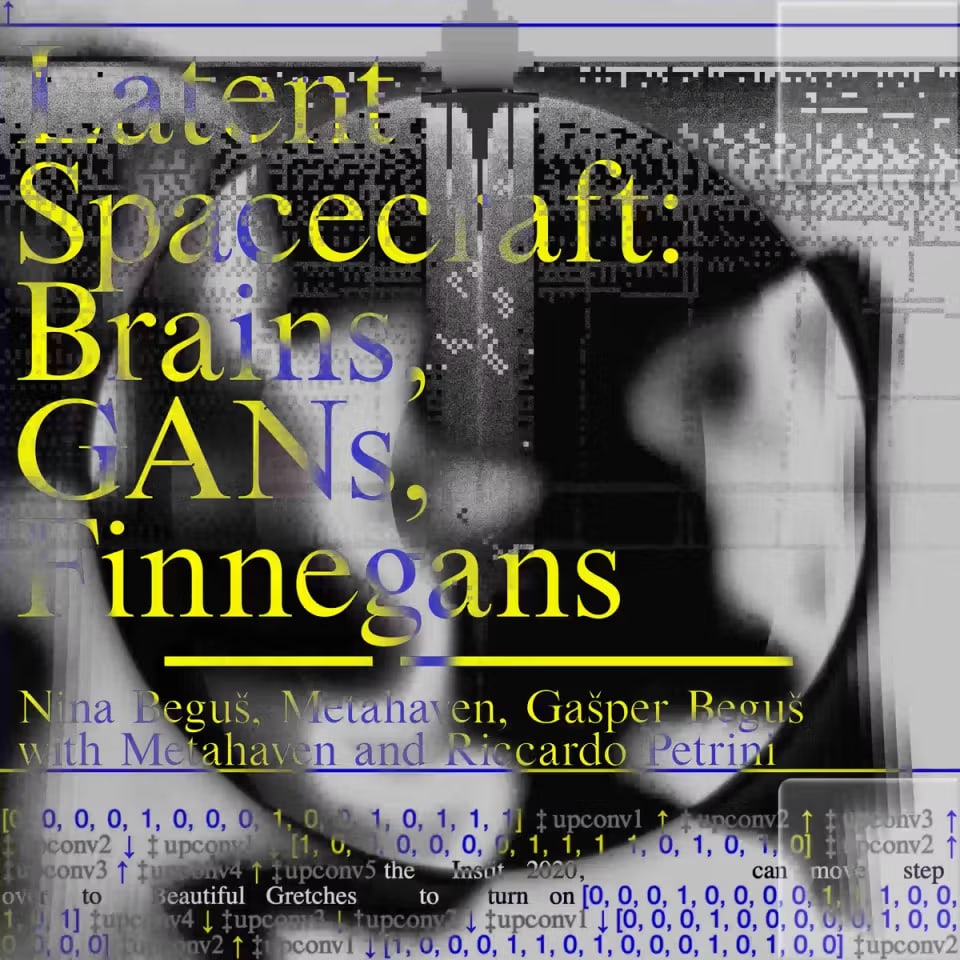
Latent Spacecraft
- Design
- Metahaven, Riccardo Petrini
- Published
- DOI
- 10.1162/ANTI.5KP1
- Length
- ~13k words
- Original
- Read the original
Latent space—the multidimensional, representational substrate of neural networks—is a structure akin to architectural interiority that renders the abstract legible. A GAN trained on *Finnegans Wake* exposes the homologies between biological and synthetic language.
Summary#
"Latent Spacecraft," by Nina Beguš, Metahaven, and Gašper Beguš, argues that the latent space of a neural network, the learned, high-dimensional space of vectors in which a model stores what it has extracted from its training data, should be understood as an interior with an architecture rather than as a black box. The authors make the case through three linked studies: speech-generating GANs that learn English phonology from a handful of words and spontaneously begin to combine them, James Joyce's Finnegans Wake read as an accidental narration of the latent space of language, and FinneGAN, a GAN trained on audio of the novel whose outputs oscillate between English, Irish, and glossolalia. The recurring claim is that the symbolic is physical all the way down, in silicon and in brain tissue alike, and that language is only the final layer that linearizes a space which is itself not narratable. Their answer is not to narrate it but to make it navigable, and the "latent spacecraft" is the name for whatever vessel does the navigating.
The argument#
The paper begins from a distinction between the outside and the inside of AI. Public discussion attends almost entirely to outputs. What produces them is a latent space, which the authors define as a representation space whose geometry is not scripted in advance but discovered during training from the network's architecture, its optimization procedure, and the statistical structure of its data. Two emergences are nested: the latent space emerges from learning, and language-like capacities emerge from the latent space. Each model has its own, and, quoting Antonio Somaini, controlling a latent space means controlling imagination and "the bounds of the visible."
The authors then make a materialist claim that runs through everything that follows. The numbers in a latent vector are physically instantiated in weights and voltages, whether the substrate is a chip or a cortex. They cite the primate motor cortex, where each neuron contributes a vector to a population code, and conclude that "there is little abstraction in the processing of the world." Model weights are the material geometry of a latent space; learning is the sculpting of that geometry. "Architecture" is therefore used not in the engineer's sense of a model's structure but in the revelatory sense of an interior that can be located, named, and explored.
The empirical core is Gašper Beguš's work on speaking GANs. Unlike autoencoders, which replicate, and transformers, which predict the next token, a GAN's generator never sees the training data. It starts from noise and is driven, through a minimax game with a discriminator and an information-exchange game with a Q-network, to produce outputs indistinguishable from real speech while encoding a recoverable code. Beguš calls this "informative imitation," and the surplus it produces, new words never in the data, "imagitation." The argument is that this resembles a child acquiring language more closely than a large language model does: it works from raw continuous audio rather than tokens, learns by producing and perceiving, and makes productive errors.
From there the paper turns to what it calls isomorphs: the human brain, Finnegans Wake, and FinneGAN. The brain isomorph rests on findings that GAN intermediate layers respond to the same syllable in a way that closely matches brainstem recordings, which the authors take as evidence that symbolic language is more physical and less abstract than linguistics has assumed. The Joyce isomorph reads the novel's nonce words as an interior of language made visible, a prenarrative, pre-discrete layer that Joyce reached intentionally and that GANs and babbling children reach by default. The FinneGAN isomorph pushes the novel further into its own latent space, producing speech of higher entropy than the text, which the Whisper transcriber then orders back into intelligibility.
The final move generalizes. Following John Stewart Bell on the unspeakability of quantum phenomena and David Albert on worlds that cannot be told as a single temporal story, the authors propose that latent spaces are structurally non-narratable. What Joyce, quantum description, and GAN output share is dependence on a hidden armature that must exist for the visible work to stand. Greg Lynn's reading of the Eiffel framework inside the Statue of Liberty supplies the model: an interior never meant to be seen, which can nonetheless be read. Interpretability becomes a spatial practice, and the humanities are recast as "co-cartographers of AI's interior."
Section by section#
The Fish Are Flying, Latent Spaces Are Spaces?#
The opening borrows Bernard Stiegler's image of the flying fish that briefly leaves water for air as an allegory of abstraction, the capacity to think outside one's immediate milieu. Latent spaces, the authors say, extend that capacity to machines: embeddings assign numbers to sights, words, and sounds and re-express them as points whose distances mirror meaning, what Buckminster Fuller called "geometry as thinking." They depart from Stiegler on one point, insisting that the symbolic layer is itself physical. His pharmakon, remedy and poison at once, frames the stakes: AI is a flying-fish moment if it enlarges thought and a trap if it makes us passive to outputs.
Flight evolved at least four times and was invented once; latent spaces likewise evolved first in nervous systems that compressed sensory information into distributed codes, and were invented, or discovered, a second time as a computational approximation of neural processing. The novelty is only in machines. Inventing AI is compared to inventing flight, a new space of possibility that carries new risks each time cognition is offloaded into silicon.
Latent Spaces in GANs#
This section gives the technical definition and the materialist thesis summarized above. It adds that latent spaces are finite and filtered by their training data, "creating novelty built completely on the old," and that they are "both aesthetic and utilitarian," the first of several points where the paper aligns them with built architecture. Three numbered statements close it, the last being that no vector lives outside the voltage patterns that realize it. Latent spaces are "porous interiors," open to technical, speculative, and poetic interpretation.
Language as Imagitation in GANs#
The section recounts the fiwGAN experiments in detail. A Featural InfoWaveGAN was trained on roughly 600 recordings each of eight words from the TIMIT corpus: ask, carry, dark, greasy, like, suit, water, year. Its first new word was "start," formed from "suit" and "dark"; others included "carrot," "dust," "watery," and nonce forms such as "sart," "wargi," and "greachy." The authors distinguish existing words, nonce words that could exist, and impossible words that violate English phonology.
The mechanism is then laid out. The generator is a speaker; the discriminator and Q-network together are a listener; the discriminator alone sees real data. A Pygmalion analogy is offered, Higgins directing Eliza, and the authors distinguish this from Turing-test framing: the generator is motivated simply to imitate informatively, not to pass as human. Because GANs work on continuous raw audio with no internal tokenization, they may reflect the brain more closely than LLMs. The exterior consequence is stated bluntly: LLMs are "polished and glib," GANs "noisy and unfinished," and GAN outputs often have to be read from spectrograms because the ear cannot be trusted.
The subsection on language acquisition introduces extreme value interpolation, in which a single latent variable is pushed far outside its training interval to reveal what it encodes, yielding monosemantic variables and an analogue of the linguist's underlying representation, such as the English plural stored as /-z/. The child analogy is developed through speech play: children's nonce words and "illogicisms" are treated as productive probes rather than errors, with Clarice Lispector's son declaring that "the word 'word' is ex-possible." The section's most consequential finding is spontaneous concatenation. A model trained only on isolated words began producing "suit greasy" and "box under water," and latent-space exploration located the cause in negative latent values interacting with negative weights, which the authors read as disinhibition, a biologically plausible mechanism. They claim this gives Chomsky's Merge a connectionist basis and simulates in silico the step from holistic calls to semi-compositional syntax.
GAN Isomorphs#
A short preface names the three isomorphs: the biological networks that originated language between a million and 135,000 years ago, Finnegans Wake, and FinneGAN.
The first isomorph argues that GANs progress from noise to babble to words to multiword strings without any "language organ," so the progression is an emergent property of general cognition. Children and GANs make the same overaspiration error, saying "spʰit" for "spit." The central evidence is that brainstem responses to a synthesized syllable and the discriminator's second convolutional layer track the acoustic signal in strikingly similar raw form, which the authors take to show that "abstract symbolic processing" is physical dimensionality reduction. Borges's exact map is invoked to say brains hold lossy maps rather than replicas, and a fifth-order lake on an island in a lake in Nunavut illustrates the claim that recursive language answers to a recursive world. The subsection closes on noise as the bridge between abstract structure and physical speech, in babble and in the GAN's "field radio" intermezzi.
The Latent Submersible subsection inverts the flying fish: the prefixes in "subconscious," "deep learning," and "embedding" suggest an oceanic depth at which public understanding stops. Mapping the latent vector onto a walkable plane shows the embeddings are "somewhere"; the authors refuse three-dimensional renderings, which falsely promise experiential spatiality. The walker across those vectors is the latent spacecraft, and an accompanying interface lets readers generate concatenated outputs from the negative regions of a trained model.
The second isomorph reads Finnegans Wake, whose first page already contains "passencore," "themselse," and "kidscad," as a layer of language before it becomes social. "Finnegans' kidscad is fiwGAN's sart." The novel is antisocial in the technical sense the authors give the word: its meaning is not built through the syntagmatic links social language relies on, and the reader must work across more than fifty languages, so it embodies Stiegler's idiotext. Against this they set the communal readings at Sweny's Pharmacy in Dublin, and draw a parallel with AI output as another solitary extreme that collective reading can counter. Joyce's refusal of the typewriter is read as pre-resistance to next-token prediction: a predictive system would turn "passencore" into "passenger." The compression argument follows, with figures: Agüera y Arcas's own book zips to 35 percent, Ulysses to 40, and the authors compute Finnegans Wake at 46 percent, less compressible than Ulysses but more than random data because motifs and portmanteaux recur. Close to half the novel is estimated to be nonce words.
Two further subsections widen the frame. The first asks whether Joyce was influenced by contemporary physics, citing Clive Hart, and cannot settle it; it then builds the narratability argument from Bell, Albert, and Metahaven's "non-narratable worlds," concluding that latent spaces are "an omnipotent, but nonnarratable interior" whose final layer, language, tries and often fails to externalize it. The second insists that any attempt to make this interior legible must preserve its aesthetic discomfort, since what it contains is partly what is unwanted. Kojin Karatani's architecture as metaphor and Greg Lynn's reading of the Statue of Liberty's hidden Eiffel armature supply the method: locate and explain an interior built never to be seen.
FinneGAN as Predeterministic Speech#
FinneGAN is a fiwGAN trained on the whole novel rendered by ElevenLabs text-to-speech in four-second chunks, with sixteen latent code variables and six convolutional layers. It is "mimetic of the novel" rather than general. The epigraph is a Whisper transcription of one output: "Right, we inhabit a locked hole, but can we use it?" The authors contrast Joyce's coherence-under-incoherence with Hannes Bajohr's diagnosis of AI narration as cohesion without coherence. A diagram redrawn from Lem's GOLEM imagines a machine taking over the evolution of language, and the authors note a recent finding that GANs encode information in the silences between words, invented by the networks themselves, which no one yet understands.
An interface stages generation as a vertical stack of clouds, one per convolutional layer, noisy at the bottom and speech-like at the top, where Whisper transcribes. The closing subsection describes the probing technique, averaging feature maps per layer, which the authors compare to brain imaging, and gives the paper's sharpest contrast. A single FinneGAN output is transcribed by Whisper as "Power of Motsunoshi Station Lettuce Wait a ti-i-i-i" and by GPT-4o Transcribe as Irish, "a group of pig farmers were sent to the fields." Whisper is cast as the adult who orders the child's entropy; FinneGAN steps further into the novel's latent space. The authors are careful to say that Joyce knew what formed language looked like and diverted from it deliberately, whereas the GAN and the child do not.
Conclusion: Interior and Exterior in AI Cultures#
The conclusion gives two reasons for treating interiors as architectures rather than black boxes: it foregrounds a materiality that can be probed and perturbed, and it makes interpretability a spatial practice indexed by extreme interpolation, concatenation, nonce words, internal layers, and noise. The design and contestation of these interiors will shape what speech and narrative can emerge from them, which is why the humanities belong inside the work of interpretation. The last sentence concedes that latent spaces remain structurally non-narratable but "expandable, particularly at the point where language is in the process of becoming."
Key concepts#
- Latent space — The learned representation space of a neural network, a geometry of vectors and weights discovered during training; here treated as a physical interior rather than an abstraction. Latent Space
- Informative imitation — The GAN learning regime in which a generator that never sees data must produce outputs a discriminator accepts while encoding a code a Q-network can recover; the paper's model for unsupervised language acquisition. Informative Imitation
- Imagitation — Beguš's term for imitation that overshoots into invention: the new words and spontaneous concatenations a speaking GAN produces beyond its training set. Imagitation
- Latent spacecraft — The vessel, interface, or reader that traverses a latent space mapped as a walkable plane, producing an "intuitive and erratic index of the inside." Latent Spacecraft
- Non-narratable worlds — Metahaven's extension of David Albert's criterion: worlds whose entirety cannot be told as a single temporal story, a class the paper says includes quantum description, Finnegans Wake, and latent spaces. Non-Narratable Worlds
- Architecture (revelatory sense) — Not the engineer's model architecture but the interior armature, in Lynn's and Karatani's sense, that upholds a visible exterior and can be read from the inside.
- Extreme value interpolation — Driving a single latent variable far outside its training range to reveal causally what it encodes.
- Black box — The framing the paper sets itself against; an interior is something with a geography, not a sealed container. Black Box
Connections#
- Generative Topolinguistics is the closest companion piece, in agreement: it also treats the latent space of a language model as something to be manipulated and read, from tokens through geometry to topology, and cites the GAN latent-direction work this paper rests on. The two differ on the model class, transformers there and non-autoregressive GANs here, and this paper argues the GAN is the better analogue of a brain.
- Modes of Cognition, listed as related in the catalog, supplies the frame of nonconscious cognition that makes the paper's language-without-a-self claims intelligible; Hayles's argument that LLMs lack bodies yet cognize sits in mild tension with this paper's insistence that symbolic processing is physical all the way down.
- What Is Intelligence? is cited for the map-not-territory point and for the compressibility of Ulysses; the two agree that learning is compression and that language is not specifically human. The paper attributes the Ulysses figure to Agüera y Arcas's What Is Life?, which has no local text here; the same figure appears in a footnote of What Is Intelligence?.
- Existential Technologies shares the Lem reference; the GOLEM diagram here, a machine taking over the evolution of language, is a small instance of the existential technologies Konior draws from Lem, those that alter evolutionary trajectories beyond conventional epistemic frameworks.
- Substrates Unbound and Minimum Viable Interiority approach interiority from the substrate side and the agent-design side respectively; this paper's position is that interiority is geometric and material before it is experiential.
- Antikythera, the program's research statement, names language as the scaffold on which artificialized intelligence is presently built and calls LLM language "uncanny"; this paper is the journal's most detailed attempt to go inside that scaffold. Its refusal of the Turing-test framing for GANs agrees with the statement's complaint about reflectionist readings of AI. Infinity Mirror, also listed as related, shares only the broader interest in simulation interiors; the link is thematic rather than argued in either text.